
Divisions of the Skeletal System
Introduction
The human skeletal system is the framework of the body. It supports body weight, protects internal organs, provides attachment for muscles and helps produce movement. In an adult, the skeleton typically consists of 206 bones, although the number can vary slightly between individuals.
For anatomical study, the skeleton is divided into two major parts:
Axial skeleton
Appendicular skeleton
This division is based mainly on the location of bones and their roles in supporting the body and enabling movement.
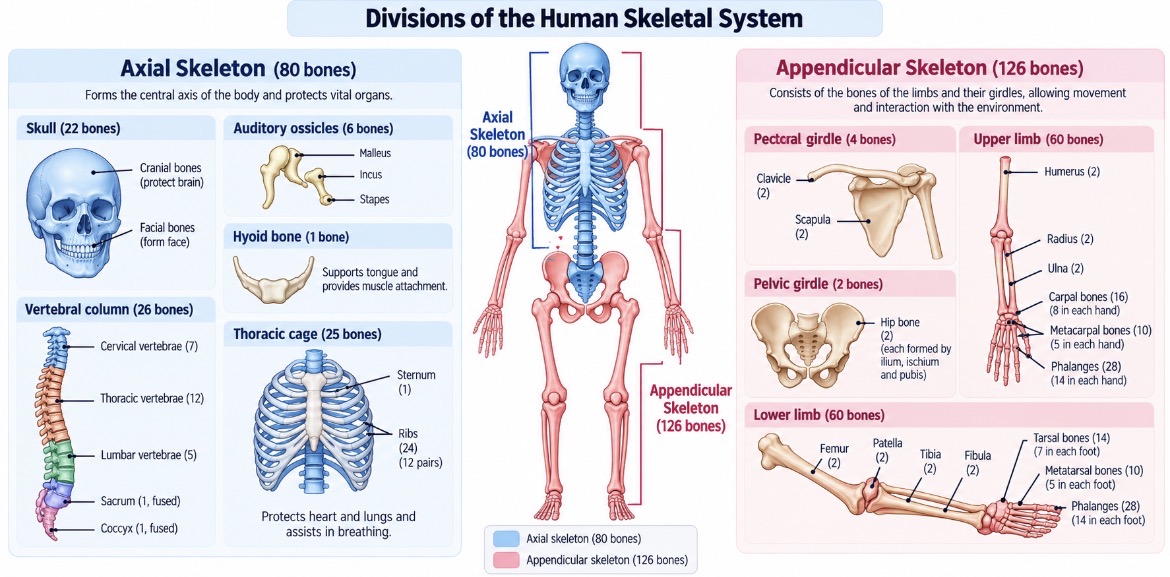
1. Axial Skeleton
The axial skeleton forms the central axis of the body. It supports the head, neck and trunk and protects important organs such as the brain, spinal cord, heart and lungs.
The adult axial skeleton typically contains 80 bones.
Major Parts of the Axial Skeleton
Skull: The skull consists of cranial bones that enclose and protect the brain and facial bones that form the structure of the face.
Auditory ossicles: These are three small bones in each middle ear—malleus, incus and stapes—which transmit sound vibrations.
Hyoid bone: A U-shaped bone in the neck that supports the tongue and provides attachment for muscles involved in swallowing and speech.
Vertebral column: The vertebral column supports the trunk and protects the spinal cord. It includes cervical, thoracic and lumbar vertebrae, the sacrum and the coccyx.
Thoracic cage: The thoracic cage consists of the ribs, sternum and thoracic vertebrae. It protects the heart and lungs and assists with breathing.
Real-life example: The skull protects the brain during everyday activities, while the rib cage protects the heart and lungs.
The axial skeleton mainly provides central support and protects vital organs.
2. Appendicular Skeleton
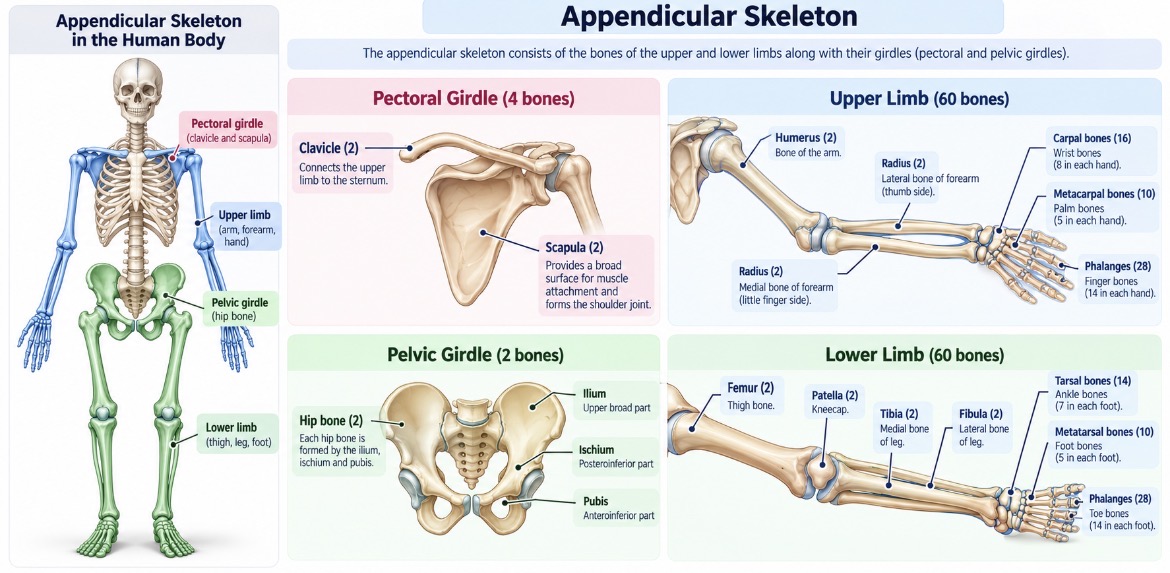
The appendicular skeleton consists of the bones of the upper and lower limbs, together with the girdles that attach the limbs to the axial skeleton.
The adult appendicular skeleton typically contains 126 bones.
Major Parts of the Appendicular Skeleton
Pectoral girdle: Consists of the clavicles and scapulae. It connects the upper limbs to the axial skeleton and allows a wide range of shoulder movements.
Upper limbs: Include the bones of the arms, forearms, wrists, palms and fingers. These bones support activities such as writing, lifting and grasping.
Pelvic girdle: The hip bones form the pelvic girdle, which connects the lower limbs to the axial skeleton and helps support body weight.
Lower limbs: Include the femur, patella, tibia, fibula, tarsal bones, metatarsals and phalanges. These bones support standing, walking and running.
Real-life example: When you walk, the bones of the lower limbs work with muscles and joints to support your weight and move your body forward.
Differences Between Axial and Appendicular Skeleton
Feature | Axial Skeleton | Appendicular Skeleton |
|---|---|---|
Main position | Central axis of the body | Limbs and their girdles |
Number of bones in a typical adult | 80 | 126 |
Major components | Skull, vertebral column, thoracic cage and associated bones | Girdles, upper limbs and lower limbs |
Main functions | Support and protection of vital organs | Movement and interaction with the environment |
Example | Skull protecting the brain | Femur helping support body weight during walking |
Important: Remember the Bone Count
Axial skeleton
80 bones
Appendicular skeleton
126 bones
Total adult skeleton
206 bones
Tip: For quick revision, remember 80 + 126 = 206. These are the standard counts for a typical adult human skeleton.
Key Concepts
The human skeleton is divided into the axial and appendicular skeleton.
The axial skeleton typically contains 80 bones and provides central support and organ protection.
The appendicular skeleton typically contains 126 bones and is primarily associated with limb movement.
Together, the two divisions account for the typical adult total of 206 bones.
In summary, the axial skeleton forms the central supporting framework of the body, while the appendicular skeleton connects the limbs and enables a wide range of movements. Both divisions work together to support, protect and move the human body.