
Neuromuscular Junction: Structure and Mechanism of Transmission
Introduction
The neuromuscular junction (NMJ) is a specialized connection between a motor neuron and a skeletal muscle fibre. It allows the nervous system to communicate with skeletal muscles and initiate muscle activity.
Whenever you perform an action such as lifting a bag, walking or writing, motor neurons transmit electrical signals to the muscles involved in that movement. At the neuromuscular junction, this signal is transmitted using a chemical messenger called acetylcholine (ACh).
Structure of the Neuromuscular Junction
The neuromuscular junction consists of three main components.
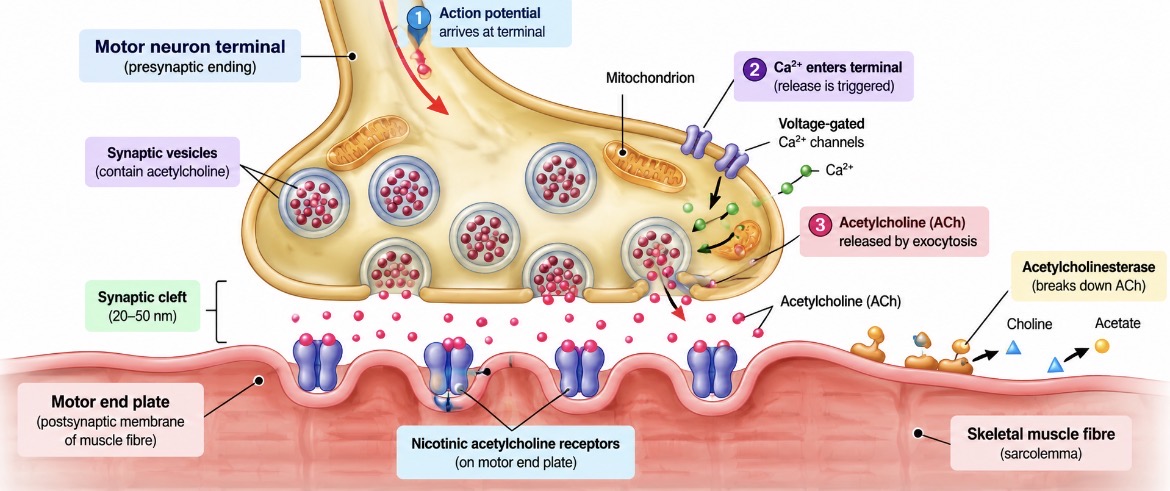
1. Presynaptic terminal: The terminal end of the motor neuron contains synaptic vesicles filled with acetylcholine. When a nerve impulse arrives, these vesicles release acetylcholine into the synaptic cleft.
2. Synaptic cleft: This is the narrow gap between the motor neuron terminal and the muscle fibre membrane. Acetylcholine crosses this gap to reach receptors on the muscle fibre.
3. Motor end plate: This is the specialized region of the muscle fibre membrane, called the sarcolemma, that contains nicotinic acetylcholine receptors.
Mechanism of Neuromuscular Transmission
Transmission at the neuromuscular junction occurs through a sequence of electrical and chemical events.
Step 1: Arrival of the Nerve Impulse
An action potential travels along the motor neuron and reaches its terminal. This changes the electrical potential of the presynaptic membrane.
Step 2: Calcium Entry into the Nerve Terminal
The arriving action potential opens voltage-gated calcium channels. Calcium ions enter the nerve terminal and trigger synaptic vesicles to release acetylcholine.
Step 3: Release of Acetylcholine
Acetylcholine is released into the synaptic cleft by exocytosis. It then diffuses across the gap towards the motor end plate.
Step 4: Activation of Acetylcholine Receptors
Acetylcholine binds to nicotinic acetylcholine receptors on the motor end plate. These receptor channels open, allowing positively charged ions to move across the muscle membrane. The resulting depolarization produces an end-plate potential.
If the threshold is reached, a muscle action potential is generated and spreads along the sarcolemma, initiating the processes that lead to muscle contraction.
Step 5: Breakdown of Acetylcholine
Acetylcholine is rapidly broken down by the enzyme acetylcholinesterase into choline and acetate. Choline can be taken back into the nerve terminal and reused to synthesize acetylcholine.
This breakdown helps terminate the signal and allows the neuromuscular junction to respond to subsequent nerve impulses.
Important: Acetylcholine initiates excitation of the muscle fibre. Calcium released from the sarcoplasmic reticulum inside the muscle fibre then enables actin–myosin interaction during contraction.
Role of the Neuromuscular Junction
The neuromuscular junction is essential for normal skeletal muscle function because it:
Transmits signals from motor neurons to skeletal muscle fibres.
Converts a nerve impulse into a response in the muscle membrane.
Initiates muscle excitation, which can lead to contraction.
Helps regulate muscle activation through controlled release and breakdown of acetylcholine.
Real-life example: When you decide to pick up a pen, motor neurons activate the relevant hand muscles. Transmission at their neuromuscular junctions helps initiate the muscle activity needed to grip the pen.
Clinical Significance
Disorders affecting neuromuscular transmission can cause muscle weakness.
Myasthenia gravis: An autoimmune disorder in which antibodies commonly target acetylcholine receptors at the neuromuscular junction. This reduces effective transmission and causes muscle weakness that often worsens with activity.
Botulinum toxin: This toxin interferes with acetylcholine release from nerve terminals. As a result, affected muscles may become weak or paralysed.
These examples demonstrate that normal muscle activity depends on effective communication between motor neurons and muscle fibres.
Key Concepts for Examination
The neuromuscular junction is the connection between a motor neuron and a skeletal muscle fibre.
Its main components are the presynaptic terminal, synaptic cleft and motor end plate.
Acetylcholine is the neurotransmitter responsible for transmission at the skeletal neuromuscular junction.
Calcium entry into the nerve terminal triggers acetylcholine release.
Acetylcholine binds to nicotinic receptors and produces depolarization of the motor end plate.
Acetylcholinesterase breaks down acetylcholine and terminates its action.
Successful neuromuscular transmission initiates muscle excitation.
In summary, the neuromuscular junction converts a nerve signal into a response in skeletal muscle. Acetylcholine carries the chemical signal across the synaptic cleft, receptor activation initiates a muscle action potential, and acetylcholinesterase terminates the signal to support controlled muscle activity.