
Introduction
Nervous tissue is a specialized tissue that receives stimuli, processes information, and transmits electrical signals throughout the body. It forms the main communication network of the nervous system and helps coordinate body activities.
Nervous tissue is mainly found in the brain, spinal cord, and nerves. It allows us to think, remember, feel pain, move our muscles, and respond to changes in our surroundings.
For example, when you accidentally touch a hot utensil, sensory receptors detect the heat and activate nerve pathways. Signals travel through the nervous system, helping your body respond quickly by withdrawing your hand.
Structure of Nervous Tissue
Nervous tissue consists of two major types of cells:
Neurons: Specialized cells that receive and transmit nerve signals.
Neuroglia (glial cells): Supporting cells that protect, nourish, and maintain the environment around neurons.
Neurons are responsible for communication, while neuroglia support the proper functioning of nervous tissue.
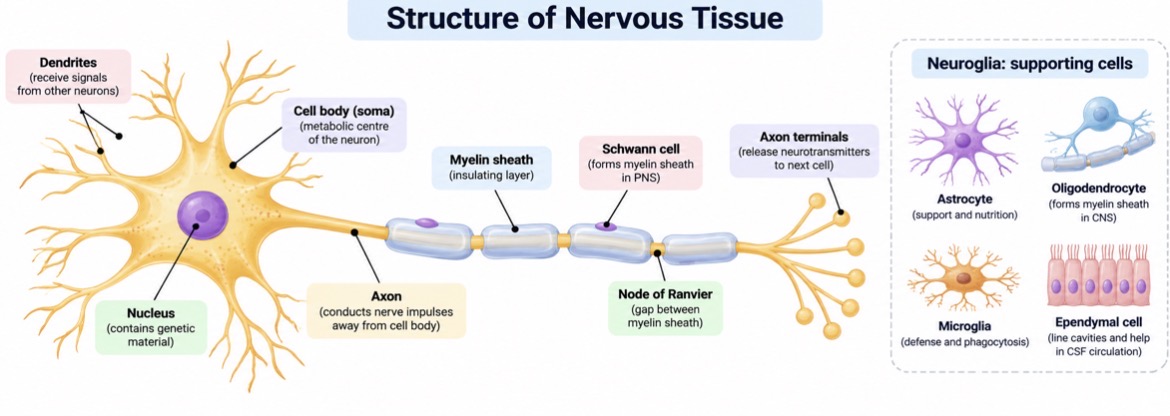
Neuron: The Functional Unit of Nervous Tissue
A neuron is the basic structural and functional unit of the nervous system. It is specialized to receive information and transmit nerve impulses to other neurons, muscles, or glands.
The main parts of a neuron are:
Cell body (soma): Contains the nucleus and maintains the activities of the cell.
Dendrites: Receive signals from other cells and carry them towards the cell body.
Axon: Carries nerve impulses away from the cell body.
Myelin sheath: An insulating covering around certain axons that helps nerve impulses travel faster.
Axon terminals: Form connections with other cells and release chemical messengers called neurotransmitters at many synapses.
Real-life example: When you touch a hot surface, sensory neurons carry information towards the central nervous system, helping trigger a protective response.
Neuroglia: Supporting Cells
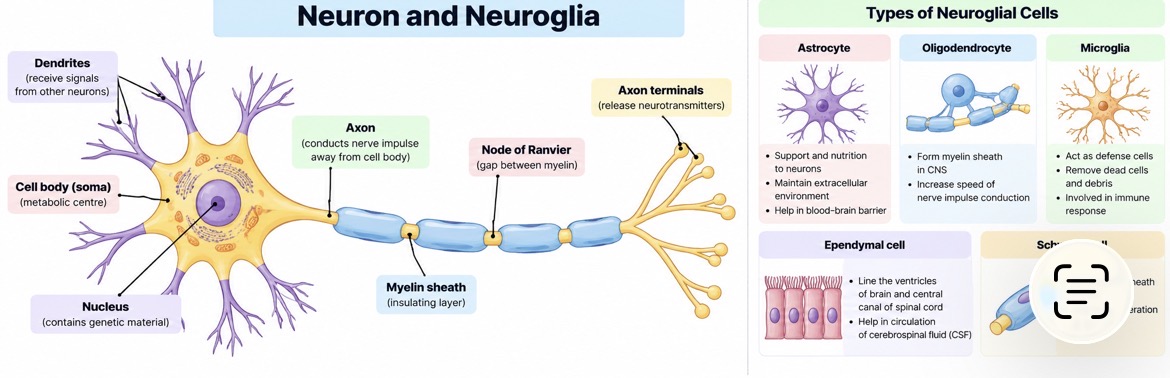
Neuroglia, also called glial cells, support and protect neurons. Unlike neurons, most glial cells are not specialized for transmitting nerve impulses over long distances.
Their functions include:
Providing structural and metabolic support.
Maintaining the chemical environment around neurons.
Forming myelin around certain axons.
Helping protect nervous tissue from damage and infection.
Examples include astrocytes, oligodendrocytes, microglia, and ependymal cells in the central nervous system. Schwann cells perform an important myelin-forming role in the peripheral nervous system.
Important: Neurons transmit information, while neuroglia help maintain the environment needed for neurons to function properly.
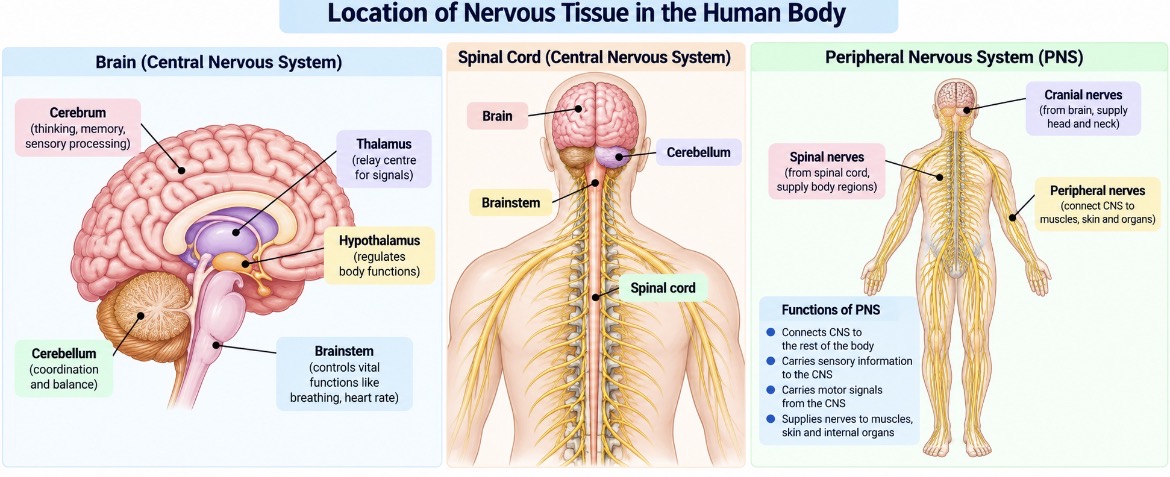
Location of Nervous Tissue
Nervous tissue is distributed throughout the body as part of the nervous system.
Brain: Processes sensory information, supports thinking and memory, and coordinates many body activities.
Spinal cord: Carries signals between the brain and body and participates in reflex actions.
Peripheral nerves: Connect the central nervous system with muscles, organs, skin, and other tissues.
How Does Nervous Tissue Transmit Signals?
Nervous tissue communicates through electrical signals called nerve impulses and chemical messengers called neurotransmitters.
The process can be understood in three steps:
Reception: Dendrites or specialized sensory endings receive a stimulus.
Transmission: An electrical impulse travels along the neuron when the appropriate conditions are met.
Communication: At a synapse, the neuron may release neurotransmitters that pass the signal to another cell.
For example, when you touch something hot, sensory neurons carry information toward the spinal cord. Motor pathways can then activate muscles to withdraw your hand. This rapid protective response is called a withdrawal reflex.
Tip: Remember the direction of information flow in a typical neuron: dendrites → cell body → axon → axon terminals.
Functions of Nervous Tissue
Sensory reception: Detects stimuli such as touch, pain, temperature, light and sound.
Information processing: Helps the brain and spinal cord interpret incoming signals.
Motor control: Sends signals that control skeletal muscles and influence other effectors.
Coordination: Helps coordinate body activities and responses to changes.
Memory and learning: Supports the processes involved in storing and retrieving information.
Regulation of internal organs: Helps regulate functions such as heart rate, digestion and glandular secretion through the autonomic nervous system.
Key Concepts
Nervous tissue is mainly composed of neurons and neuroglia.
Neurons receive and transmit information.
Neuroglia support, protect and maintain nervous tissue.
Nervous tissue is found in the brain, spinal cord and peripheral nerves.
Electrical impulses and chemical neurotransmitters enable communication between cells.
In summary, nervous tissue acts as the body's communication and coordination system. Its specialized cells help us sense our surroundings, process information, produce movements and regulate essential body functions.