
Introduction to Muscular Tissue
Introduction
Muscular tissue is a specialized type of tissue in the human body that produces movement by contracting and relaxing. It is made up of elongated cells called muscle fibres, which can generate force when stimulated.
Muscular tissue helps us perform everyday activities such as walking, writing, lifting objects, breathing and pumping blood throughout the body. It also supports internal functions, including the movement of food through the digestive tract.
For example, when you bend your arm to lift a book, the muscles in your arm contract and produce the force needed for movement. Similarly, your heart continuously contracts to pump blood, even when you are sleeping.
General Structure of Muscular Tissue
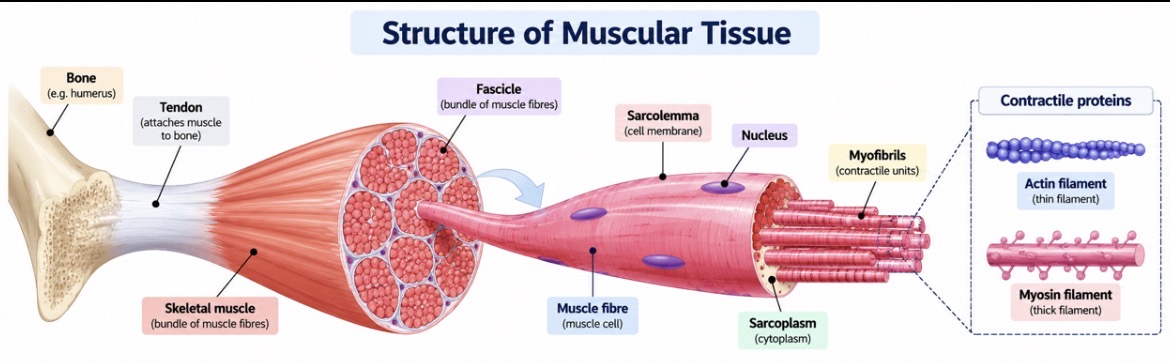
Muscular tissue consists of specialized cells containing contractile proteins, mainly actin and myosin. These proteins interact with one another to produce contraction.
The basic structural features of muscular tissue include:
Muscle fibres: Elongated cells that form muscular tissue.
Actin and myosin: Contractile proteins responsible for generating force.
Sarcolemma: The cell membrane of a muscle fibre.
Sarcoplasm: The cytoplasm of a muscle fibre.
The arrangement of these structures varies among different types of muscles and determines how they contract and perform their functions.
How Does Muscular Tissue Work?
Muscular tissue works through the coordinated process of contraction and relaxation.
Stimulation: A muscle receives a suitable stimulus, usually through a nerve signal or, in some cases, through internal electrical activity.
Contraction: Contractile proteins interact and generate force.
Movement or force production: The muscle produces movement or helps maintain tension in a body structure.
Relaxation: The muscle returns to a less contracted state when the contraction process ends.
In skeletal muscle, calcium ions help regulate the interaction between actin and myosin. Energy in the form of ATP is required for normal muscle contraction and relaxation.
Real-life example: When you pick up a school bag, your nervous system activates the muscles of your arm. These muscles generate force and move your forearm to lift the bag.
Important: Muscle contraction does not always mean that a muscle becomes shorter. A muscle can also produce force while maintaining its length or while lengthening under load.
Types of Muscular Tissue
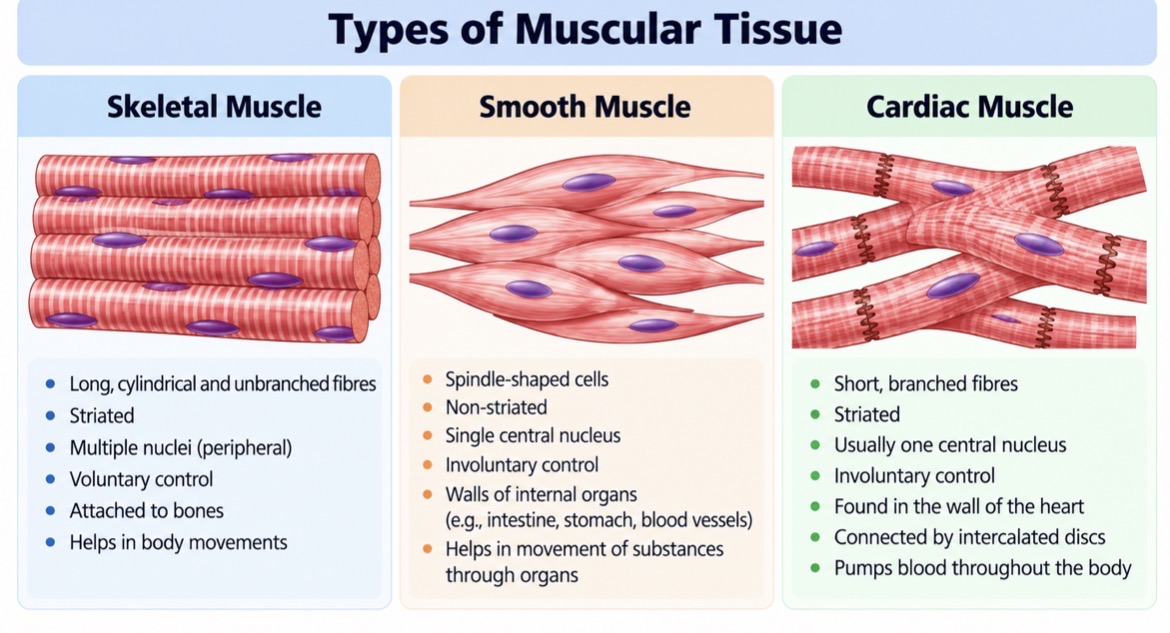
Muscular tissue is classified into three major types based on its structure, location and method of control.
1. Skeletal Muscle
Skeletal muscle is generally attached to bones through tendons and helps produce voluntary body movements.
Its cells are long, cylindrical and contain multiple nuclei. Under a microscope, skeletal muscle fibres show visible cross-striations.
Location: Muscles of the arms, legs, face and trunk.
Functions:
Produces body movements.
Maintains posture.
Stabilizes joints.
Generates heat during contraction.
Real-life example: Walking, running, writing and lifting a bottle involve skeletal muscles.
2. Smooth Muscle
Smooth muscle consists of spindle-shaped cells with a single central nucleus. Unlike skeletal muscle, it does not show visible cross-striations.
It is mainly controlled involuntarily, meaning that it generally functions without conscious effort.
Location: Walls of structures such as the intestines, stomach, urinary bladder and blood vessels.
Functions:
Moves food through the digestive tract.
Regulates the diameter of blood vessels.
Helps control the movement of substances through internal organs.
Real-life example: Smooth muscles in the intestinal wall contract rhythmically to move food through the digestive system. This process is called peristalsis.
3. Cardiac Muscle
Cardiac muscle forms the muscular wall of the heart, called the myocardium. Its cells are striated and usually contain one central nucleus. They connect through specialized junctions called intercalated discs, which help coordinate contraction.
Cardiac muscle functions involuntarily and contracts rhythmically to pump blood.
Location: Wall of the heart.
Functions:
Pumps blood to the lungs and the rest of the body.
Maintains blood circulation.
Supports the continuous delivery of oxygen and nutrients to tissues.
Real-life example: Your heart continues beating while you sleep, allowing blood to circulate throughout your body.
Differences Between the Three Types of Muscular Tissue
Tip: Remember the three types by their main functions: skeletal muscle moves the body, smooth muscle moves substances inside organs, and cardiac muscle pumps blood.
Major Functions of Muscular Tissue
Muscular tissue performs several essential functions:
Movement: Produces movements such as walking, running and lifting objects.
Posture: Helps maintain body position while standing or sitting.
Heat production: Generates heat during contraction, contributing to the maintenance of body temperature.
Movement of internal substances: Moves food through the digestive tract and helps empty the urinary bladder.
Blood circulation: Cardiac muscle contracts to pump blood throughout the body.
Regulation of organ activity: Smooth muscle changes the diameter of blood vessels and other hollow organs.
Clinical and Everyday Relevance
Understanding muscular tissue helps explain common bodily functions and certain medical conditions.
For example, muscle fatigue may develop during prolonged physical activity, while damage to cardiac muscle can affect the heart's ability to pump blood efficiently. Problems involving smooth muscle can also affect digestion or the regulation of blood flow.
These examples show why the structure and function of muscular tissue are important in human anatomy and physiology.
Key Concepts
Muscular tissue is specialized for contraction and force production.
Actin and myosin are the principal contractile proteins.
Skeletal, smooth and cardiac muscles differ in structure, location and control.
Skeletal muscle mainly produces body movement.
Smooth muscle controls movement within internal organs.
Cardiac muscle maintains blood circulation through rhythmic contraction.
In summary, muscular tissue enables movement, supports posture, moves substances through internal organs and maintains blood circulation. Its three types are adapted to perform these different functions throughout the human body.