
Classification of Tissues
Introduction
A tissue is a group of cells that are structurally organized and work together to perform one or more specific functions. Cells within a tissue may have similar characteristics, although they can also differ in structure and function according to the role of the tissue.
The study of tissues, their microscopic structure, organization and functions is called histology.
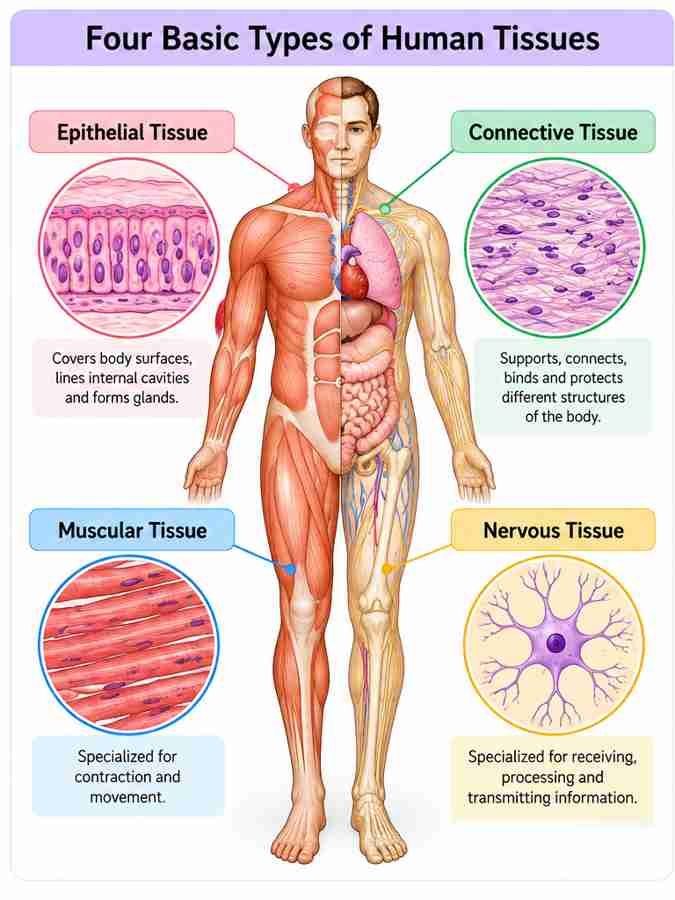
In the human body, tissues are broadly classified into four major types:
Epithelial tissue
Connective tissue
Muscular tissue
Nervous tissue
1. Epithelial Tissue
Epithelial tissue consists of closely arranged cells that cover the external surfaces of the body, line internal cavities and passages, and form many glands.
The cells are closely packed with very little space between them. This arrangement allows epithelium to form an effective covering or lining.
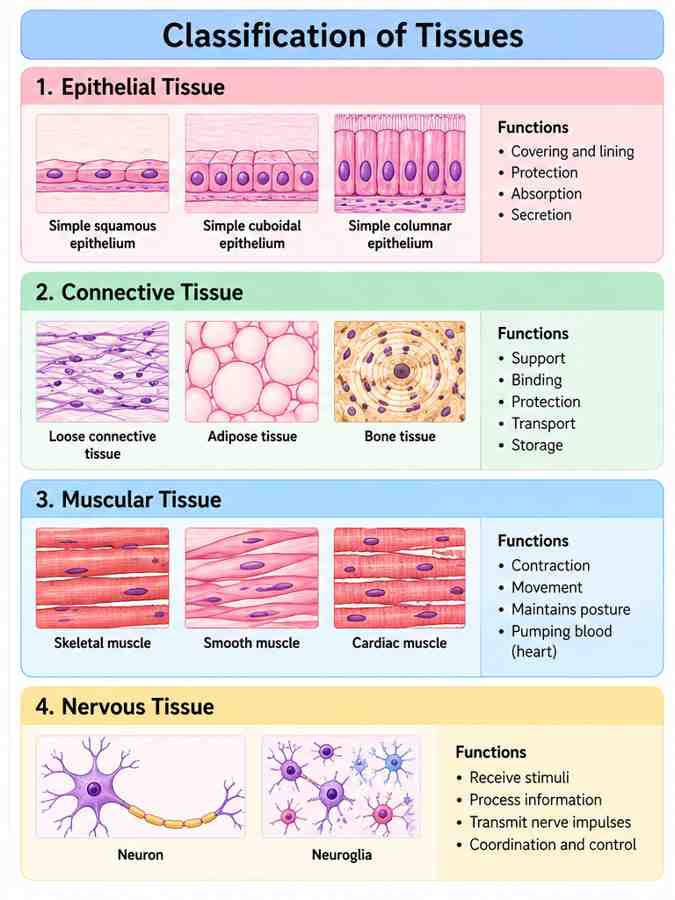
Epithelial tissue is mainly classified according to the number of cell layers and the shape of its cells.
Based on the number of layers, it may be:
Simple epithelium — one layer of cells
Stratified epithelium — two or more layers of cells
Based on cell shape, epithelial cells may be:
Squamous — thin and flat
Cuboidal — approximately cube-shaped
Columnar — taller than they are wide
Examples include the epithelium covering the skin, lining the intestine and forming the lining of blood vessels.
Epithelial tissue provides protection and also performs functions such as absorption, secretion and exchange of substances.
2. Connective Tissue
Connective tissue supports, connects, binds and protects different structures of the body. Unlike epithelial tissue, its cells are generally separated by an extracellular matrix, which consists of ground substance and protein fibres.
The major components of connective tissue are cells, fibres and ground substance. The nature and amount of these components determine the properties of different connective tissues.
Connective tissue includes:
Loose connective tissue
Dense connective tissue
Cartilage
Bone
Blood
Adipose tissue
For example, adipose tissue stores energy, cartilage provides flexible support, bone provides rigid support and protection, while blood transports substances throughout the body.
3. Muscular Tissue
Muscular tissue is specialized for contraction. Its cells contain contractile proteins that allow them to shorten and generate force.
There are three major types of muscular tissue:
Skeletal Muscle
Skeletal muscle is generally attached to bones and produces voluntary movements of the body. Its fibres are striated and are usually under conscious control.
Smooth Muscle
Smooth muscle is found mainly in the walls of hollow organs and blood vessels. Its cells are non-striated, and its contraction is generally involuntary.
Cardiac Muscle
Cardiac muscle forms the muscular wall of the heart. It is striated and contracts involuntarily in a rhythmic manner to pump blood.
4. Nervous Tissue
Nervous tissue is specialized for receiving, processing and transmitting information.
It is mainly composed of two types of cells:
Neurons are specialized cells that generate and transmit nerve impulses.
Neuroglia, or glial cells, support, protect and maintain neurons and their environment.
Nervous tissue forms the major components of the brain, spinal cord and peripheral nerves. It allows the body to detect changes, process information and coordinate appropriate responses.
Summary of Tissue Classification
Tissue | Main Function | Examples |
|---|---|---|
Epithelial | Covering, lining, protection, absorption and secretion | Skin, intestinal lining |
Connective | Support, binding, protection and transport | Bone, cartilage, blood, adipose tissue |
Muscular | Contraction and movement | Skeletal, smooth and cardiac muscle |
Nervous | Communication and control | Brain, spinal cord, nerves |
Key Concept
The four basic tissues of the human body are epithelial, connective, muscular and nervous tissue. Their different structures allow them to perform different functions, and combinations of these tissues form organs and organ systems. This classification provides the foundation for understanding the microscopic organization of the human body.