
Homeostasis and Its Regulation
Introduction
The human body is continuously exposed to changes in its internal and external environment. However, conditions such as body temperature, blood glucose, blood pressure, water balance, and electrolyte levels must remain within suitable ranges for normal body function.
The ability of the body to maintain a relatively stable internal environment is called homeostasis. It is a dynamic process because the body continuously makes adjustments rather than keeping every condition completely constant.
Homeostasis = Maintenance of a relatively stable internal environment
The detailed organization of the human body and its systems has already been discussed in the previous articles. This article focuses on how the body regulates and maintains internal balance.
What Is Homeostasis?
Homeostasis is the ability of the body to maintain physiological conditions within a relatively stable range despite continuous changes in the internal or external environment.
Examples of conditions regulated by homeostatic mechanisms include:
Body temperature
Blood glucose level
Blood pressure
Water balance
Blood calcium level
Electrolyte concentration
Homeostasis does not mean that these conditions remain exactly constant. Instead, they fluctuate within an acceptable normal range around a reference value called the set point.
Simple Example
When body temperature increases:
Body temperature increases → Change is detected → Corrective response occurs → Heat loss increases → Temperature moves toward normal
This continuous adjustment is an example of homeostasis.
Set Point and Normal Range
Set Point
A set point is the reference value around which a physiological variable normally fluctuates.
For example, human body temperature is regulated around approximately 37°C, although actual temperature normally varies within a physiological range.
Normal Range
The normal range is the acceptable range of values around the set point in which the body can function normally.
Therefore:
Set point → Reference value
Normal range → Acceptable range around the reference value
Important: The body does not maintain every physiological variable at one absolutely fixed value.
Components of a Homeostatic Control System
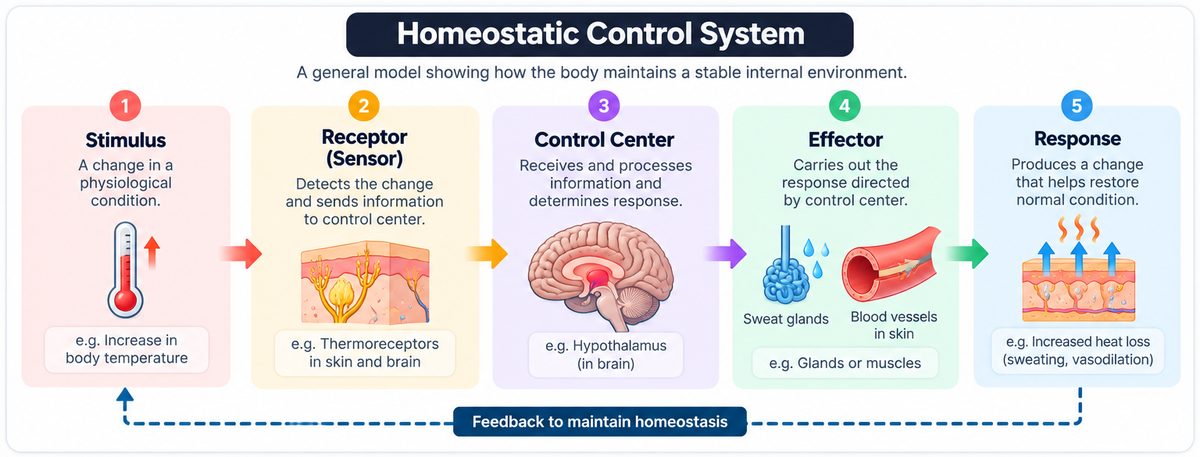
A typical homeostatic control system involves five main steps:
Stimulus → Receptor → Control Center → Effector → Response
1. Stimulus
A stimulus is a change in a physiological condition that may disturb the normal range.
Examples:
Increase in body temperature
Increase in blood glucose
Decrease in blood pressure
2. Receptor or Sensor
A receptor detects the change in the physiological condition and sends information to the control center.
3. Control Center
The control center receives and processes information from the receptor. It compares the detected condition with the appropriate range and determines the required response.
The control center may involve the brain or other regulatory structures, depending on the physiological process.
4. Effector
An effector carries out the response directed by the control center.
Effectors may include:
Muscles
Glands
Organs
5. Response
The response is the physiological change produced by the effector.
The response helps bring the regulated condition toward its appropriate range.
Overall Mechanism
Stimulus → Receptor → Control Center → Effector → Response
This feedback-loop concept is the foundation for understanding negative and positive feedback mechanisms.
Negative Feedback
Negative feedback is a regulatory mechanism in which the response opposes or reverses the initial change.
It is the major mechanism involved in maintaining homeostasis.
General Pattern
Initial change → Detection → Corrective response → Initial change decreases → Condition moves toward normal
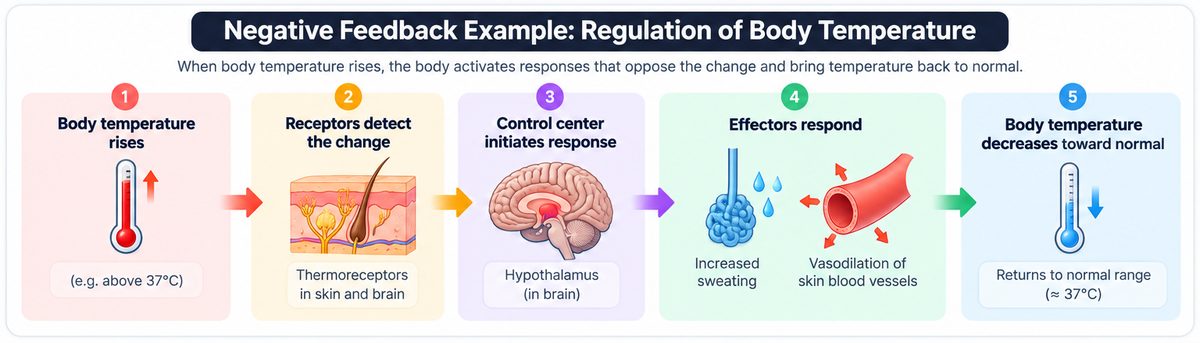
Example: Regulation of Body Temperature
If body temperature rises above its normal range:
Body temperature ↑
↓
Temperature receptors detect the change
↓
Control center initiates a response
↓
Sweating and heat loss increase
↓
Body temperature ↓ toward normal
The response opposes the original increase in temperature.
Example: Blood Glucose Regulation
After eating, blood glucose increases.
Blood glucose ↑
↓
Pancreatic cells detect the increase
↓
Insulin is released
↓
Glucose uptake and storage increase
↓
Blood glucose ↓ toward normal
This is another example of negative feedback.
Key Point
Negative feedback opposes the initial change and helps maintain stability.
Positive Feedback
Positive feedback is a mechanism in which the response reinforces or amplifies the original change.
Unlike negative feedback, it does not immediately oppose the change. Instead, the response causes further change in the same direction.
Positive feedback normally operates until a specific endpoint is reached.
General Pattern
Initial change → Detection → Response → Greater change → Stronger response
Example: Childbirth
During childbirth:
Cervical stretching
↓
Signals are sent to the brain
↓
Oxytocin is released
↓
Uterine contractions become stronger
↓
More cervical stretching
↓
More oxytocin release
↓
Stronger contractions
The cycle continues until the baby is delivered. Once the stimulus is removed, the feedback cycle stops.
Example: Blood Clotting
Blood clotting is another example of positive feedback.
When a blood vessel is damaged, the clotting process activates components that promote further clot formation. This helps rapidly form a clot and limit blood loss.
The process is localized and stops once the damaged area is effectively sealed.
Negative Feedback vs Positive Feedback
Feature | Negative Feedback | Positive Feedback |
Effect on initial change | Opposes the change | Amplifies the change |
Main purpose | Maintains stability | Drives a process toward an endpoint |
Role in homeostasis | Major mechanism | Usually not used to maintain stability directly |
Example | Body temperature regulation | Childbirth |
Another example | Blood glucose regulation | Blood clotting |
Easy Way to Remember
Negative Feedback → Normalizes the change
Positive Feedback → Progresses/amplifies the change
Homeostatic Imbalance
When the body is unable to maintain an appropriate internal environment, a homeostatic imbalance may occur.
If the imbalance is severe or persists for a long period, normal physiological functions may be disturbed and disease may develop.
Examples of conditions involving disturbances in homeostatic regulation include:
Abnormal blood glucose levels
Abnormal body temperature
Blood pressure disturbances
Fluid and electrolyte imbalance
Calcium imbalance
Understanding these mechanisms is important because many diseases involve disturbances in normal physiological regulation. The PCI syllabus specifically includes the study of homeostatic mechanisms and their imbalances.
Detailed disorders and their mechanisms will be studied with the relevant organ systems in later topics.
Importance of Homeostasis in Pharmacy
Homeostasis is important for pharmacy students because many medicines influence physiological processes that are normally regulated by the body.
For example, drug therapy can affect:
Blood glucose
Blood pressure
Fluid balance
Hormone levels
Electrolyte balance
Body temperature
Understanding homeostasis helps a pharmacy student understand how the body responds to changes and how drugs can modify these physiological processes.
This concept forms an important foundation for understanding pharmacology, pathophysiology, and drug therapy.
Quick Revision
Homeostasis
Maintenance of a relatively stable internal environment.
Set Point
Reference value around which a physiological variable fluctuates.
Normal Range
Acceptable range around the set point.
Homeostatic Control System
Stimulus → Receptor → Control Center → Effector → Response
Negative Feedback
Opposes the initial change.
Example:
↑ Temperature → Sweating → ↑ Heat loss → ↓ Temperature
Positive Feedback
Amplifies the initial change until an endpoint is reached.
Example:
Cervical stretching → Oxytocin → Stronger contractions → Delivery
Key Points
Homeostasis maintains relatively stable internal physiological conditions.
Homeostasis is a dynamic process, not complete constancy.
A set point is the reference value around which a physiological variable normally fluctuates.
The normal range represents acceptable variation around the set point.
A homeostatic control system involves a stimulus, receptor, control center, effector, and response.
Negative feedback opposes the initial change and is the major mechanism for maintaining homeostasis.
Positive feedback amplifies the initial change and generally continues until a specific endpoint is reached.
Body temperature and blood glucose regulation are examples of negative feedback.
Childbirth and blood clotting are examples of positive feedback.
Failure of homeostatic regulation can lead to physiological imbalance and disease.
Exam-Oriented Questions
Short Answer Questions
Define homeostasis.
What is a set point?
What is meant by normal range?
List the components of a homeostatic control system.
Define negative feedback.
Define positive feedback.
Give two examples of negative feedback.
Give two examples of positive feedback.
What is homeostatic imbalance?
Long Answer Questions
Define homeostasis and explain its importance in the human body.
Explain the components of a homeostatic control system.
Explain negative feedback with a suitable example.
Explain positive feedback with a suitable example.
Differentiate between negative and positive feedback mechanisms.
FAQs
What is homeostasis?
Homeostasis is the ability of the body to maintain relatively stable internal physiological conditions despite continuous changes.
Is homeostasis the same as keeping body conditions constant?
No. Body conditions normally fluctuate. Homeostasis keeps them within an appropriate physiological range.
Which feedback mechanism is mainly responsible for homeostasis?
Negative feedback is the major mechanism responsible for maintaining homeostasis.
Is positive feedback always harmful?
No. Positive feedback can be a normal physiological mechanism when it has a definite endpoint, such as childbirth or blood clotting.
Why is homeostasis important for pharmacy students?
Many drugs influence physiological processes regulated by homeostatic mechanisms. Understanding homeostasis therefore provides a foundation for understanding drug actions and physiological responses.
Conclusion
Homeostasis is the continuous process by which the human body maintains its internal environment within an appropriate physiological range. Negative feedback mainly maintains stability by opposing changes, while positive feedback amplifies selected processes until a specific endpoint is reached.
Understanding these mechanisms provides an essential foundation for studying normal physiology, disease processes, and the effects of drugs on the human body.