
Basic Life Processes: Essential Functions of the Human Body
Introduction
The human body is made up of highly organized cells, tissues, organs, and organ systems. Although these structures differ in their roles, they collectively perform a set of essential processes that allow the body to remain alive and functional.
These fundamental activities are called basic life processes.
Some of these processes occur continuously and automatically, while others may be consciously controlled.
For example:
Cells continuously carry out chemical reactions.
The body responds to changes in its environment.
Muscles produce movement.
Cells grow and become specialized.
The reproductive system enables the formation of new individuals.
The major life processes relevant to human physiology are:
Organization
Metabolism
Responsiveness
Movement
Growth and development
Reproduction
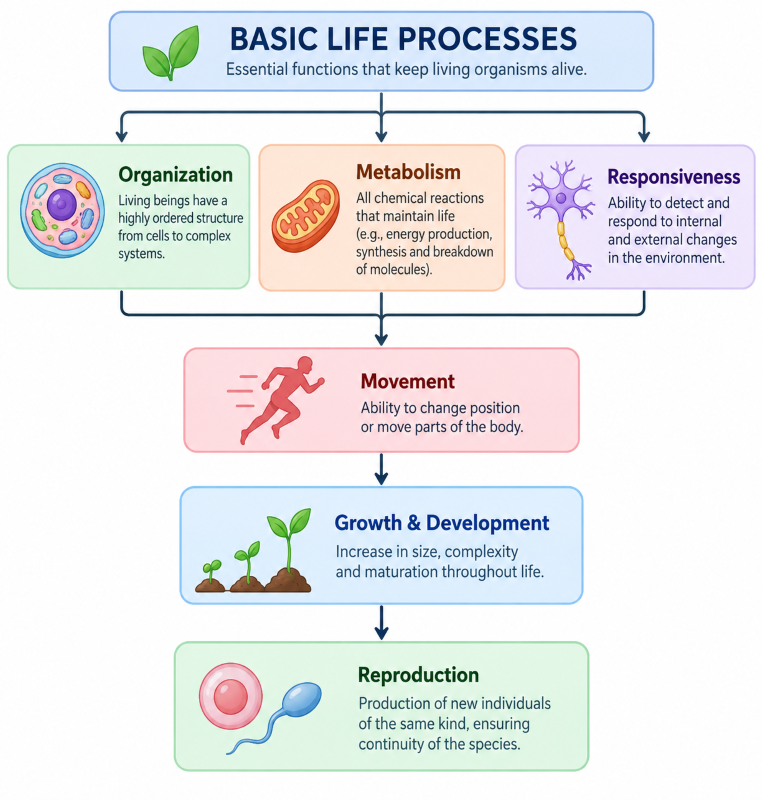
These processes are interconnected rather than completely independent.
Note: The structural organization of the body has already been discussed in detail in [Levels of Structural Organization]. Here, organization is included only to show its role as a characteristic of living systems.
1. Organization
Organization refers to the ordered arrangement of structures and processes that allows the human body to function as an integrated living system.
The human body is organized hierarchically:
Chemical → Cellular → Tissue → Organ → Organ System → Organism
At each level, structures work together to support the functions of the next level.
For example:
Cells → Cardiac tissue → Heart → Cardiovascular system → Human body
The detailed levels of structural organization have already been covered in:
Related article: Levels of Structural Organization of the Human Body
This organization is essential because the body cannot function properly if its structures are not coordinated.
2. Metabolism
Metabolism is the sum of all chemical reactions occurring within the body.
These reactions allow cells to:
Obtain and use energy
Build necessary molecules
Break down substances
Maintain cellular structures
Support normal body functions
Metabolism includes two broad types of reactions:
Anabolism
Anabolism is the process of building larger and more complex molecules from smaller molecules.
Examples include:
Formation of proteins from amino acids
Formation of glycogen from glucose
Synthesis of cellular components
Anabolic reactions generally require energy.
Catabolism
Catabolism is the breakdown of larger and more complex substances into smaller molecules.
Examples include:
Breakdown of glucose
Breakdown of stored nutrients
Breakdown of molecules to release usable energy
Catabolic reactions generally release energy.
Together
TogetherAnabolism → Builds molecules → Uses energy
Catabolism → Breaks molecules → Releases energy
Both together → METABOLISMThe energy released or transferred during metabolism is used to support cellular activities. ATP is a major energy-transfer molecule used by cells.
Simple Example
After eating a meal:
Food → Digestion → Smaller molecules → Absorption → Cellular metabolism
Some nutrients are used immediately, while others can be stored or used to build body components.
B.Pharm Connection
Metabolism is particularly important in pharmacy because drugs can:
Affect metabolic pathways
Be chemically modified by the body
Influence energy metabolism
Undergo metabolic transformation before elimination
The detailed study of drug metabolism belongs to pharmacology and biochemistry and does not need to be covered here.
3. Responsiveness
Responsiveness is the ability of the body or its cells to detect and respond to changes in the internal or external environment.
A change that produces a response is called a stimulus.
Examples
External stimulus
A person touches a hot object.
Heat → Sensory detection → Nervous response → Hand withdrawal
Internal stimulus
Body temperature increases.
Temperature increase → Physiological response → Sweating and increased heat loss
The ability to respond to stimuli allows the body to adapt to changing conditions.
Why Is Responsiveness Important?
Without responsiveness, the body would not be able to:
Detect danger
Adjust to environmental changes
Maintain internal conditions
Coordinate physiological activities
The nervous and endocrine systems are particularly important in coordinating many responses, although many other tissues and organs also participate.
4. Movement
Movement is another fundamental characteristic of human life.
Movement does not mean only walking or running.
At the human-body level, movement includes:
Walking
Running
Changing posture
Moving limbs
At the organ level, it includes:
Heart contractions
Movement of food through the digestive tract
Expansion and contraction of the lungs
At the cellular level, it includes:
Movement of cells
Movement of substances within cells
Changes in cell shape
Therefore, movement occurs at multiple levels of organization.
Example: Movement of Food
Food moves through the digestive tract due to coordinated contractions of smooth muscle.
This movement is called peristalsis.
Example: Blood Movement
Cardiac muscle contraction produces the force required to move blood through the circulatory system.
B.Pharm Connection
Understanding movement is important for later study of drugs affecting:
Skeletal muscle
Smooth muscle
Cardiac muscle
Gastrointestinal motility
Neuromuscular transmission
5. Growth and Development
Growth
Growth is an increase in the size of the body or one of its parts.
Growth can occur through:
Increase in cell number
Increase in cell size
Increase in extracellular material
For example, bones increase in size during development through coordinated cellular and tissue processes.
Development
Development refers to the changes that occur in the body throughout its life.
Development includes processes such as:
Growth
Differentiation
Maturation
Repair
Differentiation
Cell differentiation is the process through which relatively unspecialized cells develop specialized structures and functions.
For example:
Unspecialized cell
↓
Differentiation
↓
Specialized cell
↓
Neuron / Muscle cell / Epithelial cell / Blood cell
Different specialized cells can then perform different functions within tissues and organs.
Growth and differentiation are important parts of normal development.
6. Reproduction
Reproduction is the biological process through which new organisms are produced.
At the level of the human organism, reproduction involves the coordinated functions of the male and female reproductive systems.
At the cellular level, cells can also reproduce by cell division.
Why Is Reproduction a Life Process?
Reproduction is not required for an individual person to remain alive at a particular moment.
However, it is essential for the continuation of the human species.
The reproductive system produces specialized reproductive cells and supports the processes required for the formation of a new individual.
B.Pharm Connection
Understanding reproductive physiology provides a foundation for later topics involving:
Contraceptives
Fertility medicines
Reproductive hormones
Hormonal therapies
Detailed reproductive physiology is covered when the reproductive system is studied.
How Are the Basic Life Processes Connected?
The basic life processes do not occur independently.
Consider a person performing physical exercise.
Organization
Cells, tissues, organs, and organ systems are arranged so they can work together.
↓
Metabolism
Cells increase energy production to meet the increased demand.
↓
Movement
Muscles contract to produce physical activity.
↓
Responsiveness
The body detects changes such as increased temperature and oxygen demand.
↓
Growth and Repair
Cells continuously maintain and repair body structures.
↓
Reproduction
Specialized reproductive processes allow continuation of the species.
This shows that the life processes collectively support the functioning of the human organism.
Basic Life Processes at a Glance
Life Process | What It Means | Simple Example |
|---|---|---|
Organization | Ordered arrangement of body structures | Cells → tissues → organs |
Metabolism | Chemical reactions of the body | Breaking down glucose |
Responsiveness | Response to internal or external changes | Withdrawal from heat |
Movement | Movement of the body or its parts | Walking, heartbeat, peristalsis |
Growth & Development | Increase, maturation and specialization | Child growing into an adult |
Reproduction | Formation of new organisms | Formation of offspring |
Why Are Basic Life Processes Important for B.Pharm Students?
Understanding these processes provides a foundation for later pharmacy subjects.
For example:
Metabolism
Helps build the foundation for understanding biochemical pathways and drug metabolism.
Responsiveness
Helps explain how the nervous and endocrine systems respond to drugs and physiological changes.
Movement
Helps in understanding drugs affecting muscles, the heart, airways, and gastrointestinal tract.
Growth and Development
Provides a foundation for understanding developmental physiology and how medicines may affect growing tissues.
Reproduction
Provides a foundation for reproductive and hormonal pharmacology.
Therefore, basic life processes help connect normal physiology with later studies of disease and drug action.
Important Concept: Life Processes Work Together
A healthy human body does not perform one life process at a time.
Instead, multiple processes occur simultaneously.
For example, while you are reading this article:
Your cells are performing metabolism.
Your nervous system is processing information.
Your eyes are responding to visual stimuli.
Your muscles are maintaining posture.
Your heart is continuously contracting.
Your cells are maintaining and repairing themselves.
This continuous activity is what allows the organism to remain alive and functional.
Key Points to Remember
Basic life processes are essential activities required for normal human life.
The major processes include organization, metabolism, responsiveness, movement, growth and development, and reproduction.
Metabolism includes both anabolic and catabolic reactions.
Anabolism builds larger molecules and generally requires energy.
Catabolism breaks down molecules and generally releases energy.
Responsiveness allows the body to detect and respond to changes.
Movement occurs at the whole-body, organ, tissue, and cellular levels.
Growth involves an increase in body size or cellular/material components.
Differentiation allows cells to become specialized.
Reproduction allows the formation of new organisms and continuation of the species.
These processes are interconnected and occur continuously in a living human body.
Exam-Oriented Questions
1. What are basic life processes?
Basic life processes are the fundamental activities performed by living organisms that are necessary for maintaining life and normal body function.
2. What is metabolism?
Metabolism is the sum of all chemical reactions occurring in the body.
3. What is anabolism?
Anabolism is the synthesis of larger and more complex molecules from smaller molecules, generally requiring energy.
4. What is catabolism?
Catabolism is the breakdown of larger molecules into smaller molecules, generally releasing energy.
5. What is responsiveness?
Responsiveness is the ability of the body or its cells to detect and respond to changes in the internal or external environment.
6. What is differentiation?
Differentiation is the process through which relatively unspecialized cells become specialized in structure and function.
7. Why is reproduction considered a life process?
Reproduction enables the formation of new organisms and ensures the continuation of the species.
Frequently Asked Questions
Is metabolism the same as digestion?
No.
Digestion breaks food into smaller substances that can be absorbed, while metabolism refers to the chemical reactions occurring within the body's cells and tissues.
What is the difference between anabolism and catabolism?
Anabolism builds; catabolism breaks down.
Does movement only mean walking or running?
No. Movement also includes heartbeat, movement of food through the digestive tract, breathing movements, cellular movement, and other internal movements.
Is growth the same as development?
No.
Growth mainly refers to an increase in size, while development includes broader changes such as maturation and cellular differentiation.
Is reproduction necessary for an individual to stay alive?
No. Reproduction is not necessary for the immediate survival of an individual, but it is essential for continuation of the species.
Conclusion
The human body remains alive because its cells, tissues, organs, and organ systems continuously perform essential life processes.
The major processes are:
Organization → Metabolism → Responsiveness → Movement → Growth & Development → Reproduction
These processes are interconnected and occur continuously rather than independently.
For a B.Pharm student, understanding them provides the basic physiological foundation needed before moving into more detailed topics such as cellular physiology, homeostasis, pharmacology, pathophysiology, and therapeutics.