
Normal Anatomical Position
Introduction
Anatomy uses a standard language to describe where a structure is located, how it is related to another structure, and in which direction a body part moves. For these descriptions to remain consistent, the human body is described from a fixed reference position called the normal anatomical position.
Whether a person is sitting, lying down, or moving, anatomical descriptions are generally made by imagining the body in this standard position.
Understanding the anatomical position is therefore the first step before learning terms such as superior, inferior, anterior, posterior, medial, lateral, proximal, distal, flexion and extension.
What is the Normal Anatomical Position?
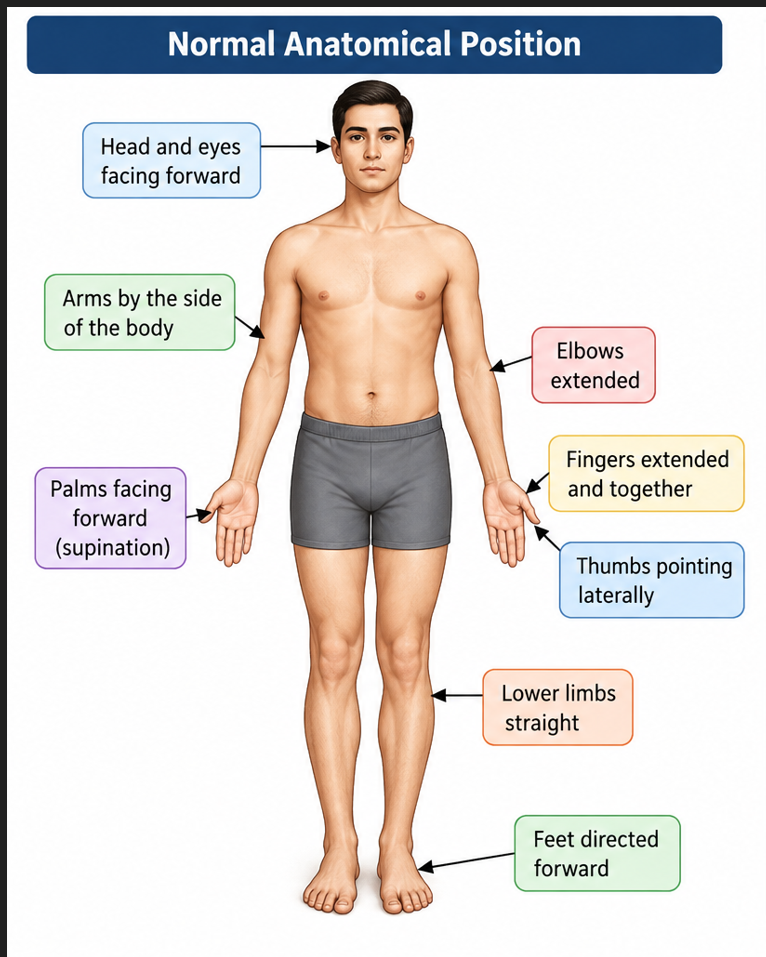
The normal anatomical position is the standard reference position of the human body in which the person is standing upright, facing forward, with the upper limbs by the sides and the palms facing forward.
The important feature is that the body is considered from this fixed position even when an individual is actually in another position.
Features of the Anatomical Position
In the anatomical position, the person:
stands erect with the body upright;
keeps the head straight and the face directed forward;
keeps the eyes looking forward;
keeps the upper limbs by the sides of the body;
keeps the elbows extended;
keeps the forearms supinated;
keeps the palms facing forward;
keeps the fingers extended and together;
keeps the thumbs pointing laterally;
keeps the lower limbs straight;
keeps the feet directed forward.
The position of the palms is particularly important. In the anatomical position, the palms face forward and the thumbs point away from the body.
Why is the Anatomical Position Needed?
The human body can be placed in many different positions. A person can lie down, sit, turn the head, bend an arm or rotate the forearm. If anatomical descriptions were based on the person's current posture, the meaning of anatomical terms would constantly change.
The anatomical position provides a fixed reference.
For example, the heart is described as being medial to the lungs. This relationship does not change simply because a person lies down or turns to one side.
Similarly, the elbow is proximal to the wrist, and the wrist is distal to the elbow. These descriptions remain constant because they are based on anatomical relationships rather than the temporary position of the body.
Anatomical Position and Directional Terms
Once the anatomical position is understood, directional terms become easier to understand.
Consider the following relationship:
Head → Neck → Chest → Abdomen → Pelvis → Lower limb
The head is superior to the chest, while the pelvis is inferior to the chest.
Similarly, the sternum is anterior to the heart, while the vertebral column is posterior to the heart.
The nose lies medial to the eyes, while the ears are lateral to the eyes.
These relationships are described using the anatomical position as the standard reference.
Anatomical Position Does Not Mean a Person Must Always Stand This Way
The anatomical position is a reference position, not a position that a person must maintain during examination or daily activities.
For example, a patient may be lying on the back during a clinical examination. The patient's actual position is different from the anatomical position, but the anatomical relationships of the structures are still described using the anatomical position as the reference.
This distinction is important because anatomical terminology describes relationships, not merely the posture of the person at a particular moment.
Anatomical Position vs Supine and Prone Positions
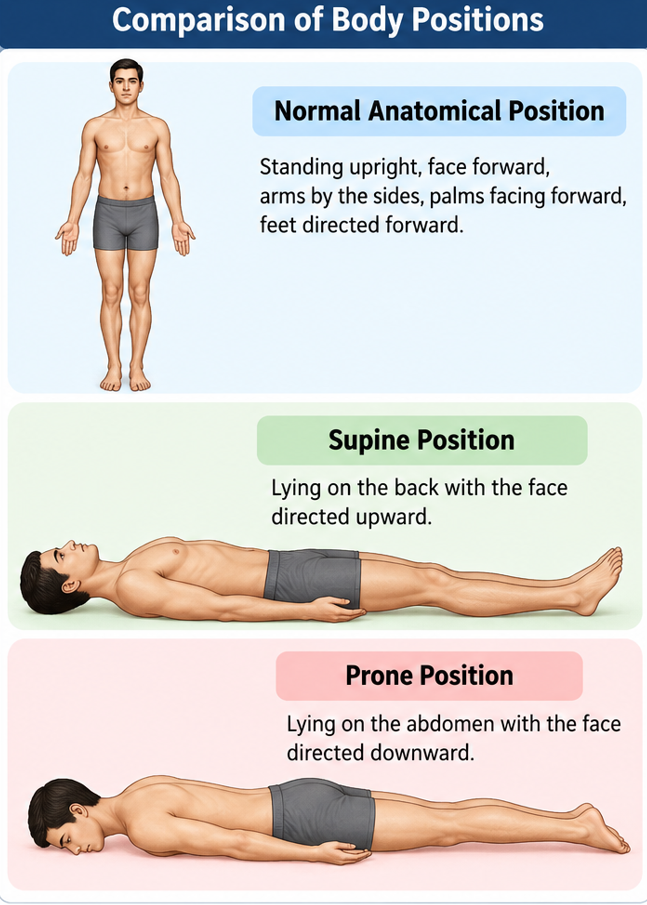
The anatomical position should not be confused with common clinical body positions.
Supine Position
In the supine position, the person lies on the back with the face directed upward.
For example, a patient lying on a bed for examination of the anterior surface of the body is usually in the supine position.
Prone Position
In the prone position, the person lies on the abdomen with the back directed upward.
For example, a patient lying on the abdomen for examination of the back is in the prone position.
Neither supine nor prone position is the normal anatomical position.
Important Anatomical Relationships from the Position
Once the body is placed in the anatomical position, several common relationships can be understood easily.
The nose is medial to the eyes because it lies closer to the midline.
The ears are lateral to the eyes because they lie farther from the midline.
The shoulder is proximal to the elbow, while the wrist is distal to the elbow.
The skin is superficial to the muscles, while the muscles are deep to the skin.
The sternum is anterior to the heart, while the vertebral column is posterior to the heart.
These examples show why the anatomical position is the foundation for the terminology used throughout anatomy.
Anatomical Position of the Upper Limb
The upper limb deserves special attention because its position can be misunderstood.
In the anatomical position:
the arm lies beside the trunk;
the elbow is extended;
the forearm is supinated;
the palm faces anteriorly;
the thumb points laterally.
The position of the forearm is important because supination places the radius and ulna parallel to each other.
When the forearm is pronated, the radius crosses over the ulna. That is a different position and is not the anatomical position.
Anatomical Position of the Lower Limb
In the anatomical position, the lower limbs are extended and the feet are directed forward.
The knees face forward, and the toes are directed anteriorly.
This standard orientation allows terms such as medial, lateral, proximal and distal to be applied consistently to the lower limb.
Why It Matters in Clinical Anatomy
The anatomical position is not limited to theoretical anatomy. It is used throughout medicine.
When a clinician describes the location of pain, an injury, a swelling, a wound or an anatomical structure, directional terms are used to communicate its exact location.
For example:
“The wound is on the lateral aspect of the right leg.”
This statement has a precise anatomical meaning because lateral is interpreted using the standard anatomical reference.
Similarly:
“The swelling is present on the medial aspect of the thigh.”
The description immediately tells the reader which side of the thigh is involved.
This common language is essential for communication between healthcare professionals.
Anatomical Position: Key Concept
The most important idea is not simply to memorize the definition.
The anatomical position establishes a constant reference system for the human body.
Once this position is understood, terms such as anterior, posterior, superior, inferior, medial, lateral, proximal and distal can be understood as relationships between structures rather than as isolated definitions.