
Introduction
The human body is three-dimensional, so describing the exact location, direction, or relationship of structures requires a standard way of dividing the body. Anatomical planes are imaginary flat surfaces that pass through the body and help describe its internal arrangement.
These planes are especially important when interpreting anatomical diagrams, cross-sectional images, CT scans, MRI scans, and other medical images.
What Is an Anatomical Plane?
An anatomical plane is an imaginary flat surface passing through the body or a body part. Depending on its orientation, a plane divides the body into different regions.
The major anatomical planes are:
Median plane
Sagittal plane
Coronal plane
Transverse plane
Median Plane
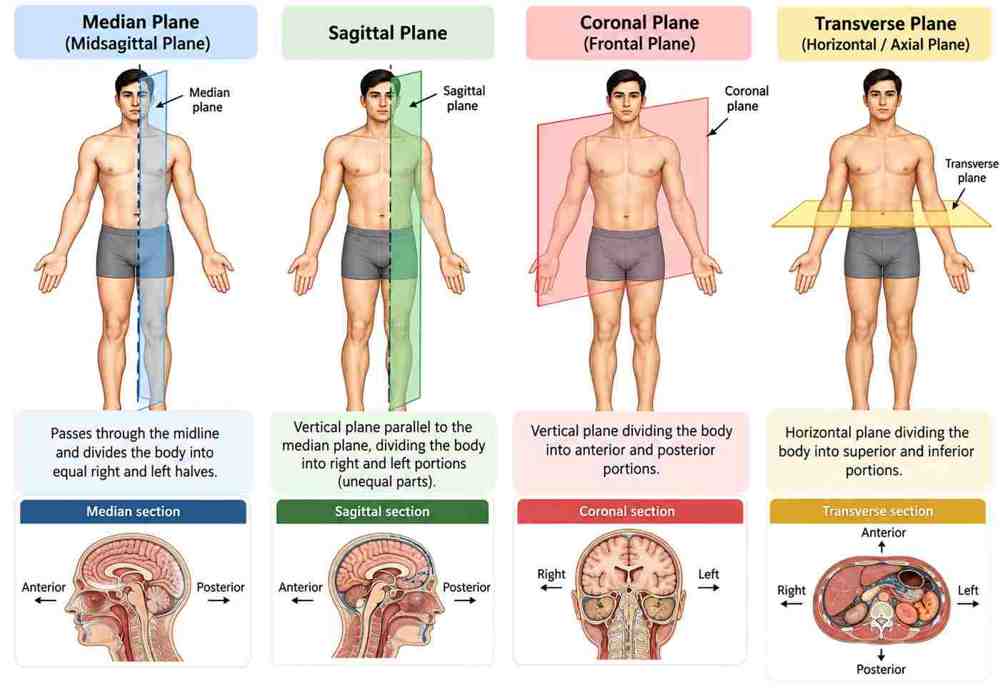
The median plane, also called the midsagittal plane, is a vertical plane that passes through the exact midline of the body.
It divides the body into two approximately equal parts:
Right half
Left half
For example, a plane passing exactly through the centre of the nose, sternum, and umbilicus would represent the median plane.
The median plane is therefore a specific type of sagittal plane because it passes through the exact midline.
Sagittal Plane
A sagittal plane is a vertical plane that divides the body into right and left portions.
Unlike the median plane, a sagittal plane does not necessarily pass through the exact midline. Therefore, the two portions may be unequal in size.
For example, a sagittal plane passing slightly to the right of the midline would produce a smaller right portion and a larger left portion.
Median Plane vs Sagittal Plane
Median Plane | Sagittal Plane |
|---|---|
Passes through the exact midline | Passes vertically to divide right and left portions |
Divides the body into approximately equal right and left halves | May divide the body into unequal right and left portions |
Also called midsagittal plane | Includes the median plane as a special type |
Coronal Plane
The coronal plane, also called the frontal plane, is a vertical plane that divides the body into:
Anterior part
Posterior part
The anterior part lies toward the front of the body, while the posterior part lies toward the back.
The coronal plane is commonly used when describing the position of structures in relation to the front and back of the body.
Transverse Plane
The transverse plane, also called the horizontal or axial plane, passes horizontally through the body.
It divides the body into:
Superior part — the upper portion
Inferior part — the lower portion
A transverse section of the abdomen, for example, provides a view of structures as they appear in a horizontal cross-section.
Transverse planes are particularly important in medical imaging, especially in CT scans, where images are commonly obtained in axial sections.
Comparing the Major Anatomical Planes
Plane | Orientation | Main Division |
|---|---|---|
Median | Vertical | Equal right and left halves |
Sagittal | Vertical | Right and left portions |
Coronal | Vertical | Anterior and posterior portions |
Transverse | Horizontal | Superior and inferior portions |
Anatomical Plane and Anatomical Section
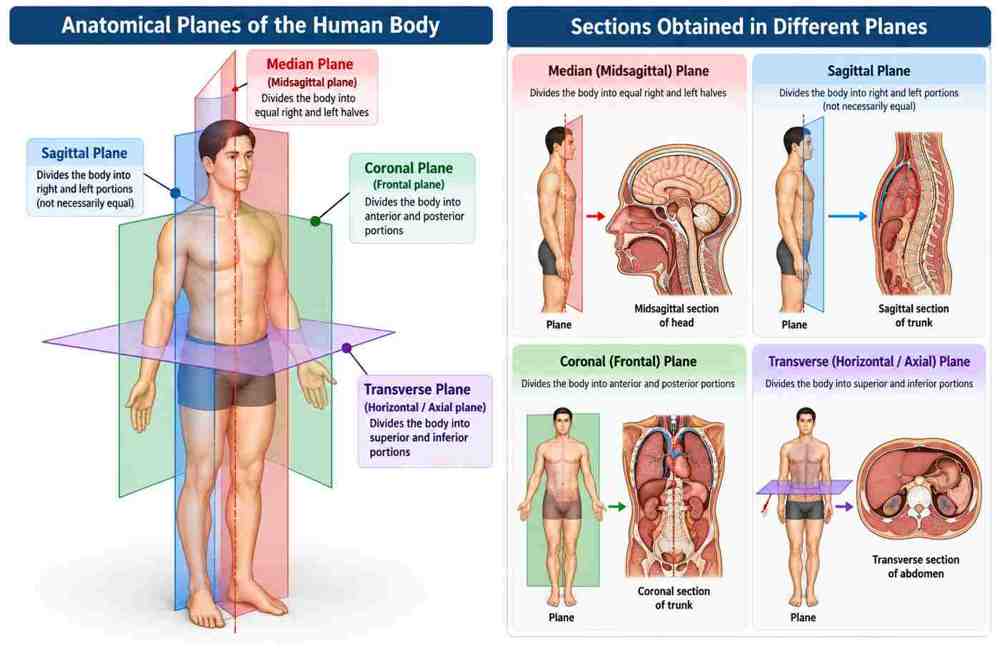
An anatomical plane is an imaginary surface used to describe how the body is divided.
An anatomical section is the actual cut or resulting view produced along a particular plane.
For example, if the body is divided along a transverse plane, the resulting view is called a transverse section.
The terms plane and section are therefore related, but they are not exactly the same. A plane describes the orientation of division, whereas a section refers to the resulting part or view.
Why Are Anatomical Planes Important?
Anatomical planes provide a standard method for describing the location and arrangement of structures within the body. They are used in:
Anatomical diagrams
Dissection
Histological and anatomical studies
CT scans
MRI
Ultrasound imaging
Surgical planning
Understanding these planes also makes it easier to interpret medical images because the same structures may appear very different depending on the plane in which they are viewed.
Clinical Relevance
Modern medical imaging frequently represents the body in different planes. CT and MRI images may be viewed as axial, sagittal, or coronal sections. Knowing the orientation of each plane allows healthcare professionals to correctly identify organs, bones, vessels, and other anatomical structures.
For example, a lesion may be described as being visible on a sagittal image or located in a particular transverse section. Without understanding the anatomical planes, such descriptions can be difficult to interpret accurately.
Key Concept
The median and sagittal planes divide the body into right and left portions, the coronal plane divides it into anterior and posterior portions, and the transverse plane divides it into superior and inferior portions.
Understanding these basic planes provides the foundation for describing the three-dimensional organization of the human body.